
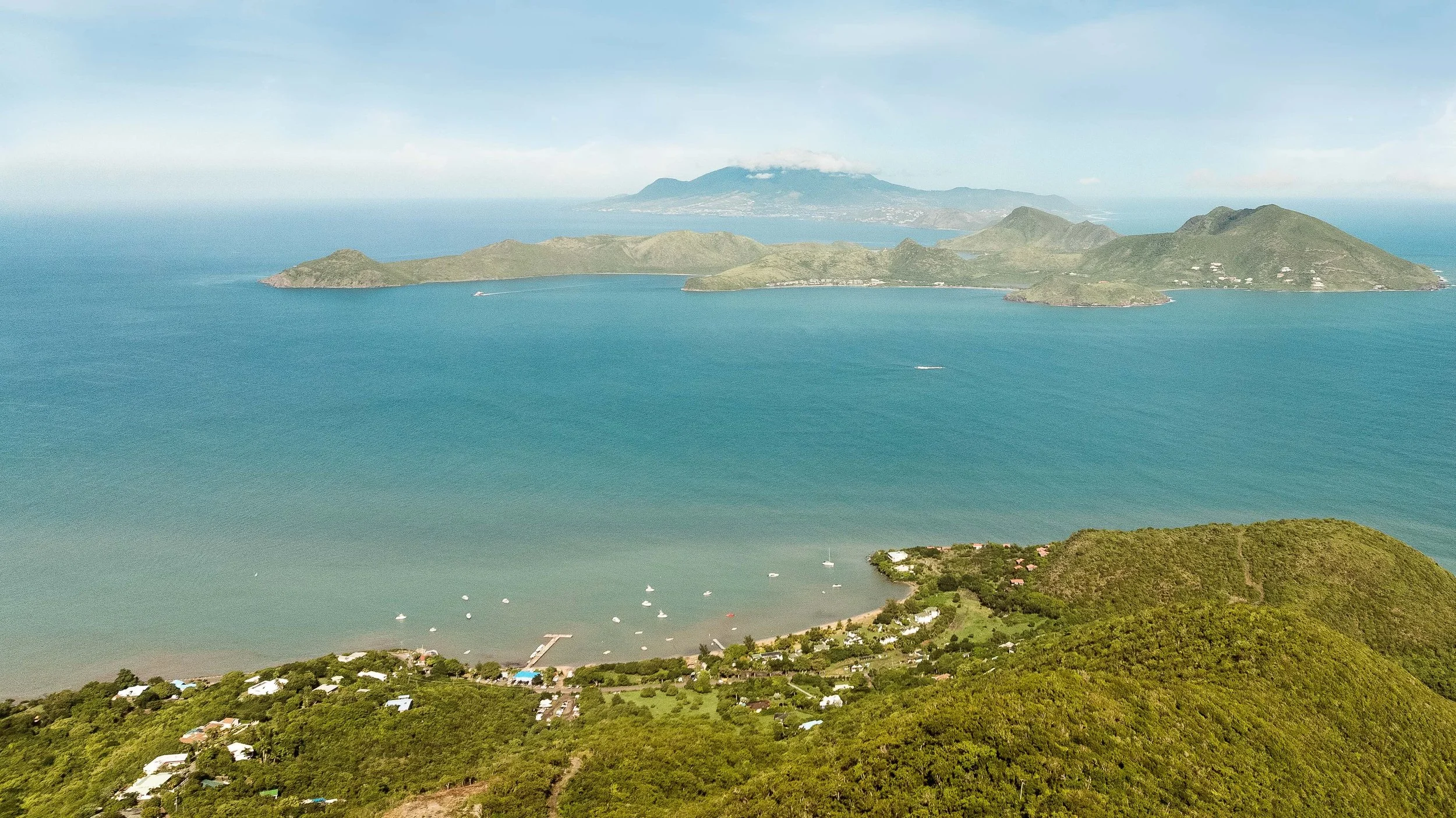
Aerial view of Nevis. Photo courtesy of Nevis Tourism Authority.
It was another beautiful day on South Caicos Island, and I sat immersed in the far-flung, Caribbean island tranquility I had come to find.
Located 81 kilometers away from the much more well-known Providenciales (the main island in the Turks and Caicos archipelago), South Caicos is an 8-square-mile outcropping that's home to just two resorts and roughly 1,139 people.
The sparse population and lack of development were exactly what attracted me to South Caicos. I'd come in search of a peaceful retreat somewhere remote enough to offer ample stretches of unspoiled nature, where I could fill my days with long, quiet walks.
But as I sat eating my lunch one afternoon at one of the two resorts on South Caicos, I couldn't help but notice the beautiful, delicate bird that had just flown overhead.
The bird had a long piece of plastic entangled around its leg, trailing behind it as it flew, not all that unlike small airplanes that tow banner advertisements through the skies in their wake.
It was a jarring moment, but one that reinforced what I already deeply understood: There is no escaping the damage humans are doing to the planet. Upon deeper reflection, however, I also realized that the moment illustrated the immense complexity of the problems at hand.
The reality is that countries located throughout the Caribbean are not the primary drivers of the many challenges the planet faces. Yet, they're the ones bearing the brunt of the countless ways humans are laying waste to the Earth. Because of that, local governments across the Caribbean have had to work twice as hard to protect their countries and their people.
That has included adapting to the brutal, existential threat posed by climate change and the many challenges it brings with it, such as sea level rise and increasingly severe weather events. In addition, the region is grappling with countless other issues – from plastic pollution to waste disposal and recycling challenges.
It also cannot be overlooked that this is a region where tourism and the steady influx of visitors are both critical to economic prosperity and are making many of the regional challenges more pressing and complex.
Amid this backdrop, I recently embarked on a series of conversations with a handful of local leaders in the Caribbean, hoping to learn more about how they're coping with some of these incredibly daunting issues.
Admittedly, the questions I came asking are so complex and nuanced that volumes could be written on the topic. Nevertheless, the conversations I was lucky to have, even if they merely scratched the surface, provided a vivid and compelling snapshot of some of the ways the Caribbean is addressing the challenges facing the planet at this moment in time.
Nevis: On the Front Lines of a War, it Didn't Start
A 36-square-mile island that sits south of Puerto Rico and west of Antigua, Nevis has proudly dubbed itself the "Queen of the Caribees." It's a title meant to underscore Nevis' unspoiled environment and distinctive old-Caribbean charm. You won't find a single fast-food chain anywhere on Nevis, nor any traffic lights or buildings taller than a coconut tree.
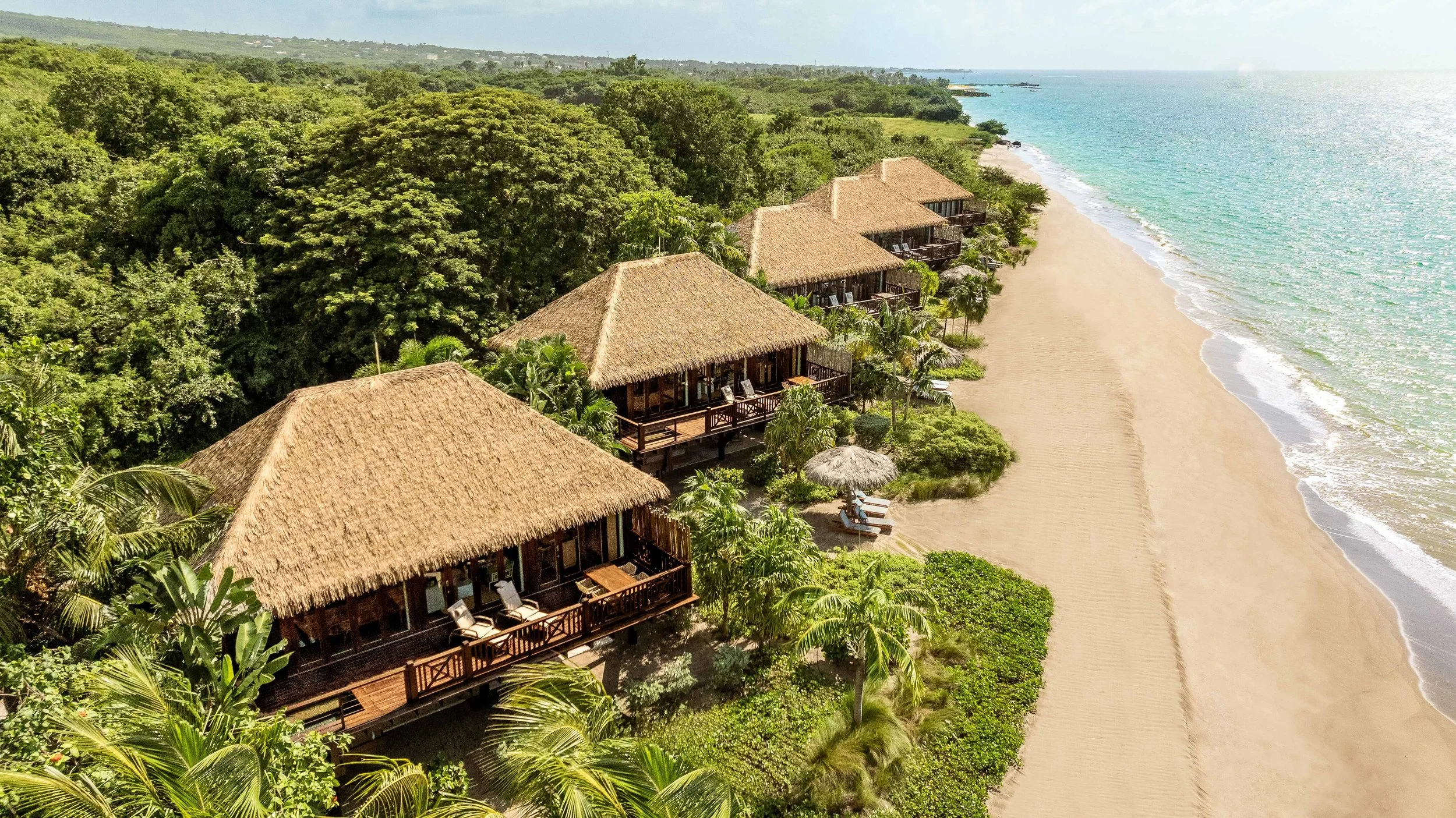
The island of Nevis. Photo courtesy of Nevis Tourism Authority.
What you will find is ancient rainforest, secluded beaches, and mountains, including Nevis Peak, a 3,232-foot dormant volcano that defines the island's landscape. Local officials in Nevis have been working diligently to protect all that makes their country special.
"The leadership in Nevis is very clear in engaging in sustainable practices. Trying to protect the island. Protect our flora and fauna. Protect our people. And ensure we preserve our way of life," Nevis Premier Mark Brantley told me.
It's an effort made increasingly daunting amid the impacts of climate change, which Brantley said is one of the most significant problems the region faces.
"We are on the front lines of a war we never started," Brantley said. "Frankly, we find ourselves being threatened existentially in circumstances where we are the victims of climate change. We are not the cause of climate change."
Countries like the United States and those throughout Europe went through an industrial revolution during the 1700s and 1800s and reaped the wealth and spoils of that development, Brantley pointed out. The Caribbean, meanwhile, is paying the price for "first world" industrialization without having shared in the rewards.
"I gave a speech at the United Nations General Assembly in 2017, and I said 'In the Caribbean, we are being asked to cash a check we didn’t write,’” Brantley explained. "What I was seeking to convey is that in a very real sense, we are being asked to carry the burden of climate change. But never got any of the benefits."
Bearing the brunt of a worsening global problem, Caribbean countries are grappling with rising oceans, coastal erosion, and beaches regularly flooded with sargassum, which are the masses of unsightly and foul-smelling brown seaweed driven by climate change and the increased level of nutrients released into the ocean amid deforestation of the Amazon.
Each of these developments poses a real threat to an industry that is the main economic pillar for much of the Caribbean: Tourism. Visitors flock to the region for sun, sand, and sea.
Sea level rise alone has the power to impact that appeal.
"Our tourism infrastructure is along our coasts. And that's not just in Nevis and St. Kitts, but in the entire region," said Brantley. "A lot of [the region’s] infrastructure is on the ocean," he continued, pointing out that just a few feet of ocean level rise would obliterate" some islands. "The Bahamas, Anguilla, low-lying islands like those, which are famous for their beaches, are just atolls in the ocean."
Local Solutions to Global Problems
Brantley is quick to point out, however, that there's only room for optimism in this battle. To that end, Nevis has been busy charting its own course in response to many of the problems at hand. That has included transitioning to renewable sources of power to help address climate change, while also tackling some of the other challenges inextricably linked to the tourism industry, such as water scarcity and pervasive plastic pollution.
One of the steps Nevis has taken to ensure ample water supplies is the development of two solar-powered desalination plants, one of which is already commissioned and generating water. In addition, the island has been tapping into underground aquifers as another source of water. Nevis also raised the cost of water for residents to encourage conservation. Thanks to this trio of efforts, Nevis does not face the same water shortages that impact other countries in the region.
As for plastic pollution, a challenge that increases exponentially anywhere there are tourists, Nevis has worked to aggressively discourage single-use plastics. Supermarkets and restaurants, for instance, are not allowed to provide plastic bags, utensils, or straws. Dealing with waste as a small island nation is also a significant regional problem. In Nevis' case, the country has partnered with Taiwan to establish a comprehensive recycling program, said Brantley.
"Anything plastic, we're crushing it, baling it, and shipping it off-island," he continued. "So far, we have shipped several 40-foot containers of plastics off this island, and we continue to do more. We just invested in a bigger facility. So, we are tackling it very, very aggressively."
Nevis' tourism model is also thoughtful and deliberate to help protect the country's resources and avoid some of the challenges associated with mass tourism. "We’re not a cruise destination, in the usual sense. We resisted the crowd," said Brantley, who explained that the largest ship that visits Nevis each year has just 900 passengers. Ships carrying 20,000 people do not port in Nevis.
"We try to go after the top one percent of the market. Our tourism model is high-yield, low-impact," he added. "We prefer 100 guests paying $1,000 a night than 1,000 guests paying $100 a night. So, we don't have to contend with some of those issues that mass tourism causes because we're not a mass tourism destination."
As important and valuable as these efforts are, the bigger challenges associated with climate change continue to loom large in the Caribbean. On this point, Brantley is somewhat introspective.
"For a very long time, we in our region sought to appeal to the morality of the First World. We sought to say to them, ‘Hey, this is a problem you caused, you should really help us out.’ But I have said to colleagues around the region that won’t work. It should not be couched in terms that say: 'You caused this problem, so you must fix it,’” Brantley told me.
"What we have to show the world is that whilst the Caribbean and Pacific and places like that find themselves on the front line, climate change is ultimately going to impact everybody," he concluded. "We may well be the first in line. And we may be on the front lines. But certainly, climate change is going to affect the entire planet. People must be made to understand that it is everybody’s best interest to deal with this problem."
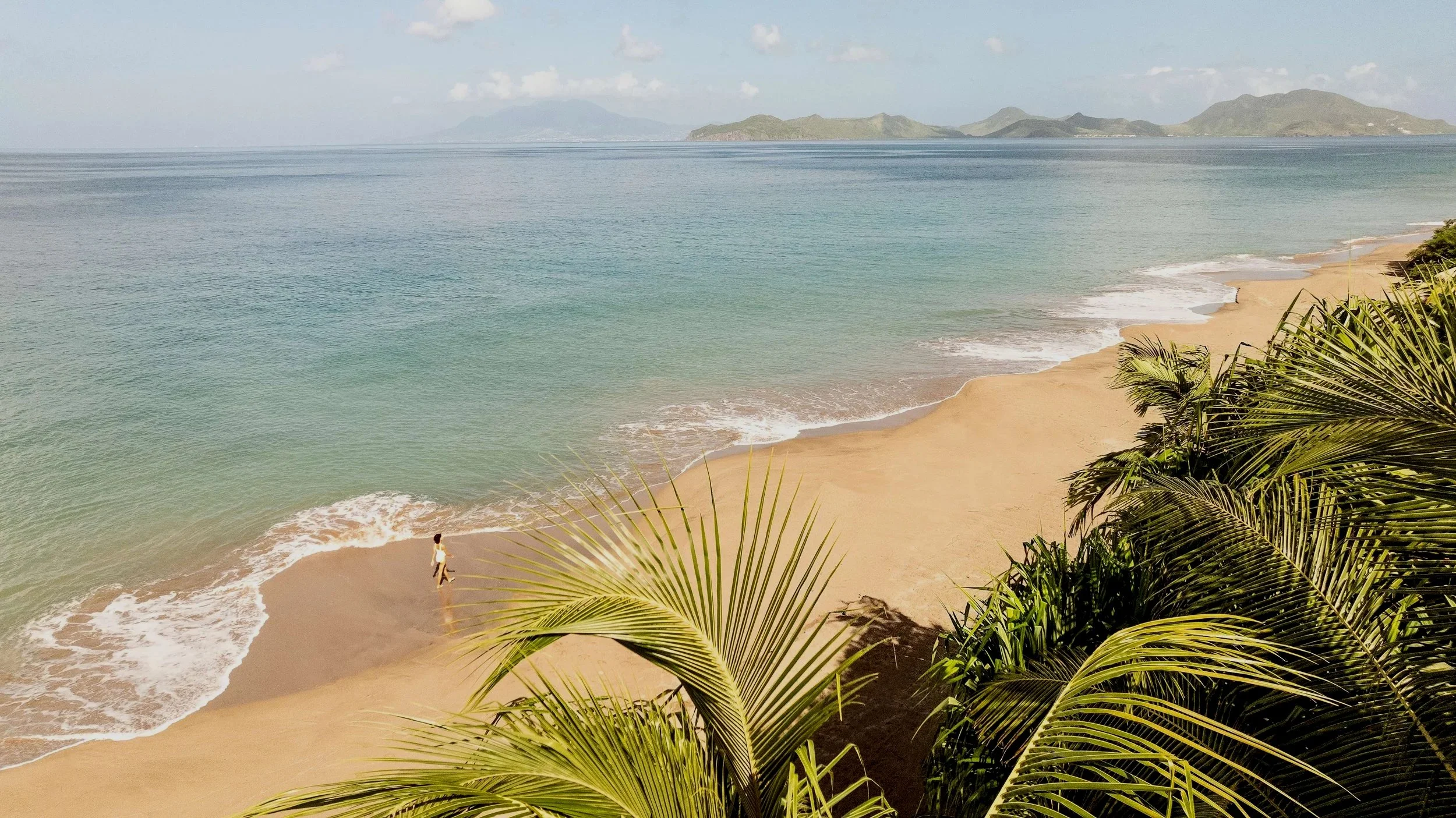
Paradise Beach in Nevis. Photo credit Nevis Tourism Authority.
Antigua and Barbuda: Creating Resiliency Amid Challenges
The climate ambassador for the government of Antigua and Barbuda, Ruleta Camacho-Thomas, was in the midst of attending COP30 in Brazil when she and I managed to connect.
During a break from the busy global forum, which she pointed out is one of the few places where the voices of countries like hers can be heard, Camacho-Thomas underscored many of the same themes and challenges as Brantley, including sea level rise, severe storms driven by climate change, water scarcity, plastic pollution, and more.
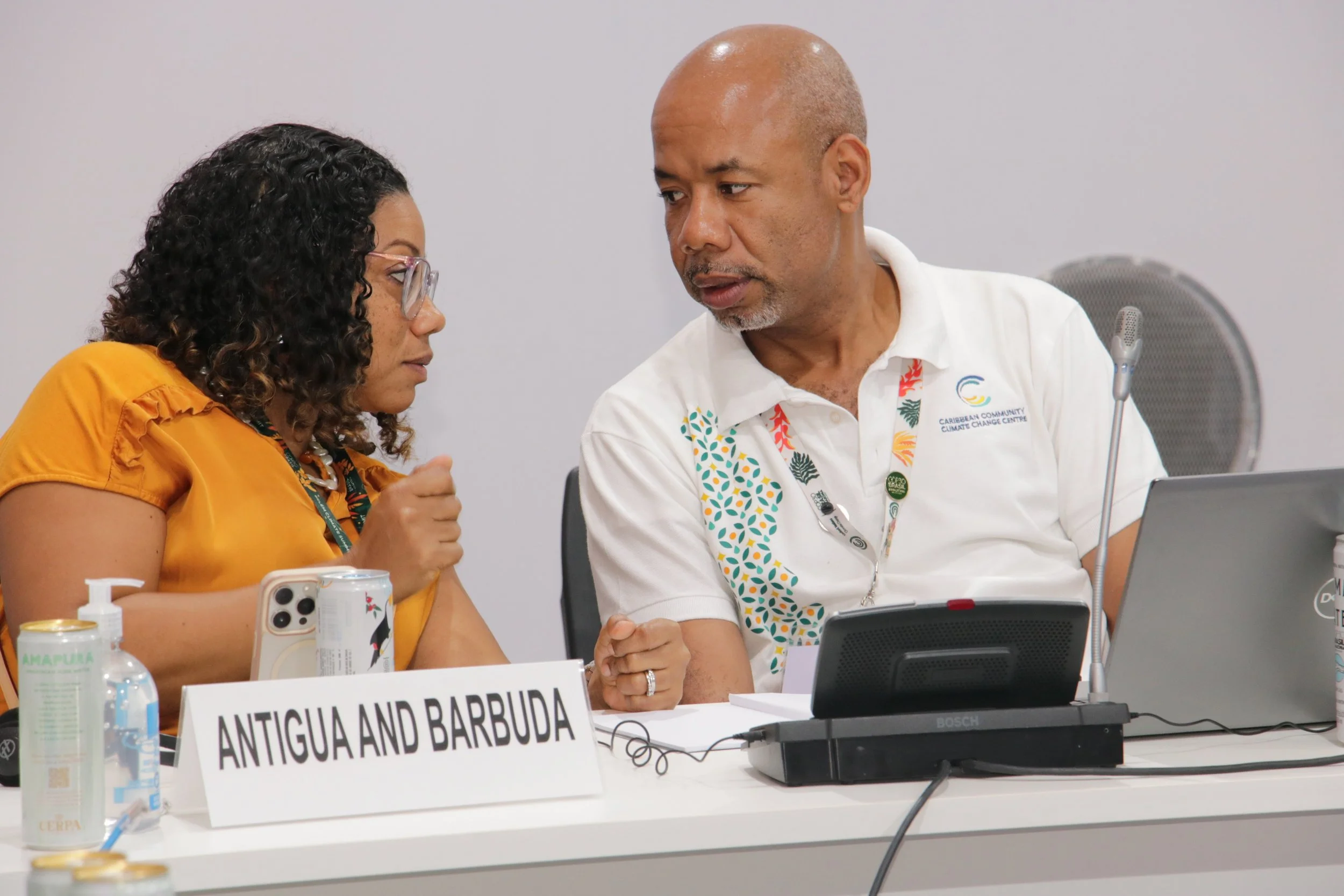

Photos Left to Right: 1) Ambassador Camacho-Thomas speaking with Jamaica's Minister of the Environment and Climate Change, Matthew Samuda. 2)Ambassador Camacho-Thomas with the Executive Director of the Caribbean Community Climate Change Centre (CCCCC) Dr Colin Young. Photo credit: Antigua and Barbuda Tourism Authority.
Like Nevis, officials in Antigua and Barbuda have been busy working to address these issues.
In response to sea level rise and storm events, for instance, Antigua and Barbuda has enshrined resilience measures into building codes for coastal properties.
"What we have realized throughout the Caribbean is that nature helps protect, but you can also apply good, sound engineering to help nature," said Camacho-Thomas. "So, when we look at development in Antigua and Barbuda…we support nature's resilience, and we also integrate resiliency into the types of buildings that are constructed."
"If you want to walk out your door and put your toes in the sand, you may just have to walk a little further," Camacho-Thomas explained. "It's part of the long-term resilience planning that people need to be aware of."
Antigua and Barbuda's building requirements make it somewhat more difficult for developers to get through the local planning and approval process, but Camacho-Thomas said that's because the country is working to ensure that properties built today are still standing in 50 years amid the realities of climate change.
Another challenge driven in part by climate change, Antigua and Barbuda is one of the most water-stressed countries in the Caribbean. And tourism adds pressure to that reality. "One of the things people don't realize is that the tourism industry takes a lot of water. Antigua and Barbuda has 100 percent desalinated water," explained Camacho-Thomas.
This is an important point and one that should not be overlooked. In 2025, Antigua opened two new seawater desalination plants, which together can produce up to 3 million gallons of drinking water daily for the country. The plants use reverse osmosis technology to convert seawater into safe drinking water—a step that not only strengthens the country's climate change resilience, but makes it weather independent, ensuring water is available to the island regardless of rainfall patterns.
Antigua and Barbuda's response to water shortage issues has also included allowing every large property to have its own desalination plant to further ensure adequate water supplies.
Dying coral reefs globally offer yet another locally felt example of the fallout from climate change. The world's coral reefs just crossed a critical thermal threshold or tipping point due to warming ocean temperatures. As a result, warm-water reefs are experiencing widespread die-offs. They are the first ecosystem on Earth to have passed that planetary tipping point.
For Antigua and Barbuda, a place with 365 beaches and associated coral reefs that tourists flock to experience (and for all of the Caribbean), this development is deeply significant. "When visitors are going out, we're asking them to be aware and understand that this may be the last time they're seeing a coral reef," said Camacho-Thomas. "This is the situation we are facing."
"We have some coral nurseries around that are doing coral conservation. And we encourage visitors when they come to ask to go and see the nurseries, so that they can see what we're doing," added Camacho-Thomas, who also pointed out that tourists can help by wearing reef-safe sunscreens when visiting the region, which are biodegradable and made from minerals, instead of chemicals that harm marine life.
"What we need to do is avoid adding any additional pressures to the ecosystems that are being threatened by climate change," she said.
Leading the Charge on Plastic Pollution
Years ago, in an effort to help tackle pervasive plastic pollution in the region, Antigua and Barbuda passed a plastic bag ban. The country also went further and prohibited styrofoam containers.
"So, you have to use paper plates, paper cups, and paper containers, which are more environmentally friendly. That's one of the concrete steps we're taking," said Camacho-Thomas. "That feeds into addressing pollution of the sea and directly connects to tourism."
Governments throughout the Caribbean have also been leading the charge on the need to enact a global plastics treaty to regulate plastic usage worldwide. It's a critical issue to the region because of the very real impacts the Caribbean faces related to plastic waste on its shores and beyond. "We actually drive this process. It's small island developing states that have made the difference in asking for ambition [about a global plastics treaty], because these problems affect us most," she said.
Antigua and Barbuda's sustainability efforts also extend to the way the country promotes itself to visitors. Tourism messaging is meant to attract a more thoughtful type of visitor, one seeking a deeper experience of the country.
"The beach is just the beginning [in Antigua and Barbuda]," said Camacho-Thomas. "We're also making sure we're promoting locally produced, community-based products. So, we're really promoting interaction with local micro-businesses as part of the experience. We're also promoting interaction with our local food culture and our art culture. So, the way we design our package is to encourage visitors who have that mindset, who would want to interact with local culture, local art, and local food."
Risks Beyond Local Control
Still, like with Brantley, the conversation inevitably returned to the looming threats of climate change and the ramifications that local government officials simply have no control over, which is a significantly more weighty challenge than issues posed by tourism.
Camacho-Thomas offered a stark example of why climate change is by far the largest threat to the region: Just before our conversation, Hurricane Melissa struck Jamaica, killing more than 45 people and causing billions of dollars in damage. "That hurricane did more damage than any tourism could have done in 150 years," she emphasized. "So, for us in this region, there's a balance. Our practitioners manage tourism…The bigger problem is actually the climate impacts, which are outside our control."
"We do not emit a high percentage of greenhouse gases. Even when you take the whole of the Caribbean together, it’s a percentage point of greenhouse gas emissions globally. It’s nothing. So, we can’t manage that issue. What we can do is manage the tourists who are coming. And we have managed it in a way that allows us to benefit from tourism and for that benefit to trickle down and even go directly to communities."
And then Camacho-Thomas posed a question (rightly so) that deserves a response. In fact, the response is long overdue:
"Nobody is asking the developed world, 'Are you stopping pollution?' 'Are you cutting fossil fuels?' Who is asking them what they are doing?" she said. "Each individual on our island has made a personal commitment to address these issues. And we have done everything we can with the resources we have. The issues we are facing now, the risks we are facing now, are not caused by us; they are caused by industries that continue to pollute."
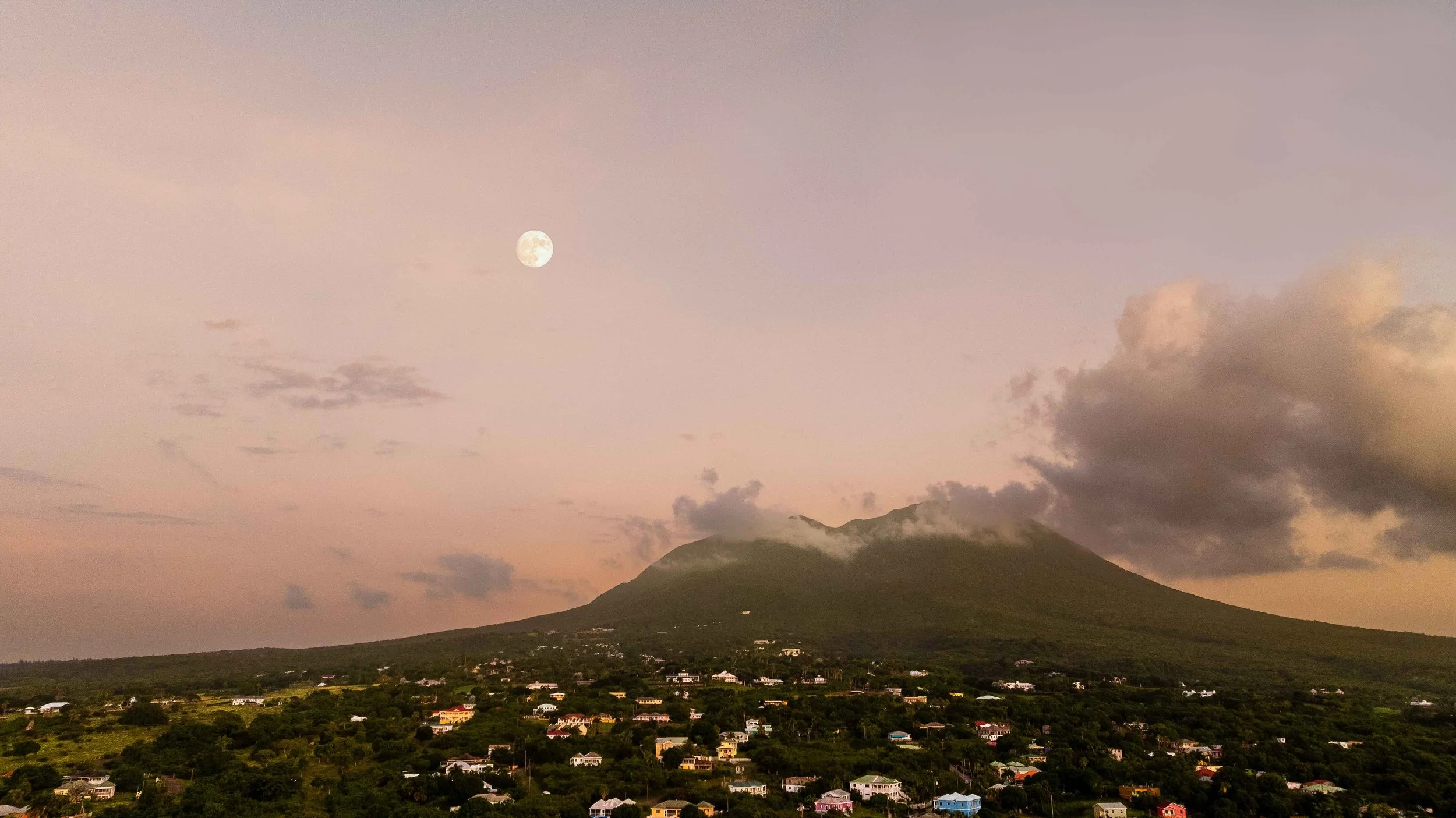
The island of Nevis. Photo credit: Nevis Tourism Authority.
South Caicos: A microcosm of global issues
My conversations with Brantley and Thomas touched upon expansive, deeply complex global challenges. Each leader provided important examples of the efforts being undertaken locally to address those issues. And they also highlighted serious shortcomings at the global level that threaten the Caribbean.
Which brings me back to my retreat on that small island of South Caicos, where I had traveled to escape it all.
My son and I spent several days at the eco-resort Salterra, a locally owned property that's part of the Marriott brand. The resort is led by a CEO, Michael Tibbetts, who's committed to the local community's well-being and to sustainability. When Salterra opened about nine months ago, it announced ambitions to become a model for sustainability in the Caribbean hospitality sector.
That effort has included engaging in a public-private partnership to install a 400-kilowatt solar system on the resort's rooftops that's meant to generate 700,000 kilowatt-hours annually (about the amount of energy consumed by 70 U.S. homes). The system is intended to offset about 20 percent of resort emissions.
Salterra has also implemented water conservation measures and waste reduction programs, including eliminating single-use plastic water bottles on its property. Additionally, the resort partners with local non-profit organizations, such as FisherFolk First, which works to help establish sustainable, small-scale fisheries. Salterra's goal is to reduce reliance on imported seafood, which is often the product of environmentally harmful supply chains.
As the resort's director of sustainability, Camilo Arado Lilleslatten, told me during one of the last days of my visit, Salterra wants to act boldly when it comes to protecting the local environment and community.
"We're a new kid on the block, but when we talk about sustainability, it's important to talk about what we are doing to change the situation and move the needle," said Arado Lilleslatten.
And then Arado Lilleslatten relays a story illustrating Salterra's commitment to bold action in South Caicos: When a neighboring resort made plans to dredge an illegal canal into nearby Admiral Cockburn Land and Sea National Park, which the government granted permission to do, Salterra stepped in and presented the facts of the situation. The canal, Arado Lilleslatten explained, would have been devastating to the island's fishing community. Salterra’s decision to voice such concerns helped to motivate a grassroots effort among local South Caicos residents, who also opposed the project.
The result? The environmentally harmful project was brought to a halt.
"Our goal wasn’t to make it seem like it was developer versus developer; we didn’t want that," said Arado Lilleslatten. "From an ecological standpoint, we were trying to emphasize the devastating impacts that dredging a canal would have on the ecosystem and economy here. The industry here is fishing. So, if you destroy the ecosystems that are supporting the livelihoods here, it’s no good."
In other words, Salterra is a property working on multiple levels to help be part of the solution and address many of the same global issues that Brantley and Camacho-Thomas raised.
There are also numerous ways guests can experience nature at Salterra, so that they return home as ambassadors who understand the importance of being mindful stewards of the planet. That includes being able to visit a local coral restoration facility that Salterra co-founded, the South Caicos Coral Reef Consortium. The consortium's efforts include establishing underwater coral nurseries and a coral lab. Hundreds of corals have already been replanted along local reefs.
My son and I were also able to spend days with Salterra guides kayaking to remote cays and past mangroves, marveling at the eagle rays and sting rays swimming beneath us. We pulled our kayaks up onto quiet sandbars to get a closer look at the stunning, almost ethereal tropical landscape surrounding us. On other days, we visited islands inhabited by iguanas or snorkeled above some of the largest, most vibrant sea stars I've ever seen.
Yet, in many of the places we went, plastic pollution was present on some level, a quiet reminder of the challenges at hand. There were some stretches of beach and rugged shorelines I explored on South Caicos, where I found plastic pollution of all types: Plastic crates, fishing lines, plastic bottles, plastic bags, and more.
As I walked in these places, I understood more clearly that this is one of many problems the global community has brought to these shores. And in the end, I realized that the questions I'd come seeking answers to, I really should have been asking leaders in the United States, throughout Europe, and beyond.
As Brantley and Camacho-Thomas made so very clear, the Caribbean is a region on the front lines of countless challenges it did not initiate.
ABOUT THE AUTHOR
Mia Taylor is an award-winning freelance travel writer and editor who has worked on staff for Parents, Real Simple, and Better Homes & Gardens. She also worked on a features writing team for BBC Travel and currently serves as a Senior Editor for the travel trade publication TravelPulse. Over the course of her career, Mia has received nine travel writing awards from the North American Travel Journalists Association. She was also a member of a team of KPBS/NPR reporters who received the Walter Cronkite Award for Excellence in Journalism. Her work has also appeared in Travel Age West, Westways, Travel + Leisure, and other publications.
Follow my travels on Instagram